
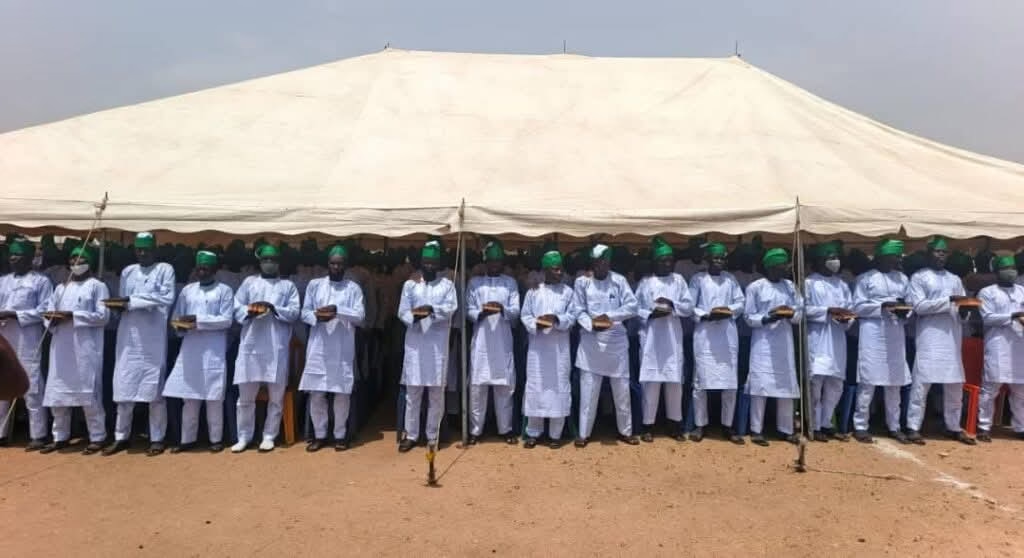
No fewer than 744 former terrorists and victims of violent extremism have completed the Federal Government’s De-radicalisation, Rehabilitation and Reintegration programme under Operation Safe Corridor.
The beneficiaries, drawn from across several states and neighbouring countries, graduated on Thursday at the programme’s camp in Gombe State. The majority hailed from Borno State, with others from Adamawa, Yobe, Kano, Katsina, and various parts of the country, alongside a few foreign nationals from Chad, Cameroon, Niger Republic, and Burkina Faso.
Speaking at the ceremony, the Chief of Defence Staff, General Olufemi Oluyede, described the initiative as a critical component of Nigeria’s counter-insurgency strategy, stressing that it should not be seen as a reward for wrongdoing.
Represented by Rear Admiral Kabiru Tanimu, Director of Special Operations Forces at Defence Headquarters, Oluyede said the programme was designed to address the root causes of extremism and promote lasting peace.
He noted that while military operations remain essential in tackling insurgency, sustainable peace can only be achieved through non-kinetic approaches such as rehabilitation and reintegration.
“This programme is not an amnesty or a sign of weakness. It is a deliberate strategy to reduce violence, discourage extremist recruitment, and strengthen long-term national stability,” he said.
The defence chief urged the graduates to embrace their second chance and contribute positively to society, warning against any return to violence.
“You have been given an opportunity to rebuild your lives. Use it wisely by becoming responsible citizens and rejecting all forms of extremism,” he added.
Earlier, the Coordinator of Operation Safe Corridor, Brigadier General Yusuf Ali, explained that the initiative was established as a structured response to insurgency, combining security efforts with humanitarian interventions.
According to him, participants underwent comprehensive rehabilitation processes, including psychosocial support, vocational training, religious reorientation, civic education, and behavioural transformation.
He noted that many of the beneficiaries were victims of coercion, abduction, or manipulation, emphasizing that the programme provides them with a pathway to rebuild their lives.
“Today marks a turning point for these individuals. They now have the opportunity to redefine their future and contribute meaningfully to national development,” Ali said.
He also stressed that successful reintegration requires the support of state governments, community leaders, families, and other stakeholders.
In his remarks, Gombe State Governor, Muhammadu Yahaya, represented by his Senior Special Assistant on Security Matters, Ambassador Yusuf Musa, called on the graduates to see the programme as a fresh start.
He reaffirmed the Federal Government’s commitment to peacebuilding under the leadership of President Bola Tinubu, urging the beneficiaries not to betray the trust placed in them.
The latest batch of graduates highlights Nigeria’s continued shift toward combining military operations with non-kinetic strategies in addressing insurgency, particularly in the North-East.
Operation Safe Corridor, established in response to the Boko Haram conflict, has evolved into a multi-agency initiative focused on de-radicalisation, rehabilitation, and reintegration. The programme continues to play a significant role in reducing recidivism, weakening extremist networks, and promoting community-based peacebuilding across affected regions.