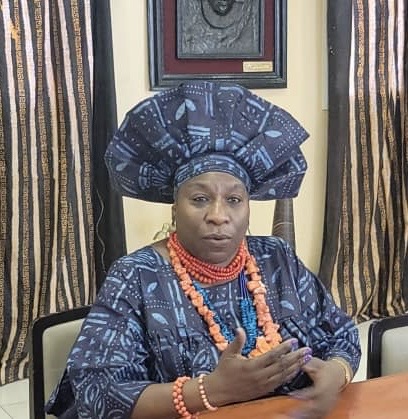
By Omobolaji AdekunleFormer Ogun State Commissioner for Health, Iyabo Obasanjo, has reaffirmed her commitment to contesting for elective office, describing politics as a system built on relationships, grassroots engagement and acceptance within a political structure.She made this known during a press conference held at the Olusegun Obasanjo Presidential Library in Abeokuta, where she addressed journalists on her political aspirations, governance priorities and national matters.Obasanjo emphasised that politics extends beyond electioneering, noting that sustained human connection and active participation within a political family are critical to success. She likened political engagement to professional networks where collaboration and mutual support are essential.“Politics is about warmth, acceptance and human connection. If no one checks on you within your party, then something is wrong,” she said, adding that she feels appreciated within the All Progressives Congress (APC).Reacting to speculations that she might withdraw from the race in favour of another aspirant, Obasanjo dismissed the claims, insisting she remains fully committed.“I wouldn’t be consulting across the state and investing this much effort if I wasn’t prepared to run. I am in the race to the very end,” she declared.Health Sector AssessmentOn the state of Ogun’s health sector, the former commissioner declined to offer a direct evaluation without conducting a fresh assessment. She recalled that during her tenure, she personally toured the 28 general hospitals and several primary healthcare centres across the state before forming policy decisions.According to her, effective leadership requires firsthand information and factual analysis rather than assumptions.“To assess properly, you must go to the field and gather facts. Without that, it would be inappropriate to make conclusions,” she stated.Call for Legislative Term LimitsObasanjo also advocated reforms aimed at strengthening Nigeria’s democracy, including the introduction of term limits for lawmakers similar to those imposed on executive office holders.She argued that spending about 16 cumulative years in national political office should be sufficient, adding that democracy thrives when leadership positions are not treated as lifelong careers.Development Agenda for OgunOutlining her development blueprint, Obasanjo identified industrialisation, agriculture, education, tourism and transportation as priority sectors.She commended the steady growth of manufacturing industries in Ogun State, describing industrial expansion as a catalyst for job creation and increased internally generated revenue.On agriculture, she stressed the need for value addition and agro-processing, noting that Ogun’s strategic location near major markets and export routes presents economic opportunities. She urged the state to prioritise processing agricultural produce locally rather than exporting raw materials.In education, she proposed establishing a specialised science and technology secondary school to nurture young talents early. She also highlighted the potential of ICT hubs and call centres to create employment opportunities for youths.Obasanjo described tourism as largely untapped, citing increased visitor traffic to Abeokuta through the Lagos-Ibadan rail corridor. She called for improved hospitality infrastructure and enhanced promotion of cultural and historical attractions to boost revenue generation.She further underscored the importance of improving road safety and transport efficiency, especially as industrial activities continue to increase heavy truck movement across the state.National Economic OutlookCommenting on national economic trends, Obasanjo pointed to improvements in currency stability, infrastructure development and expanding international trade relations as positive indicators.According to her, a stable naira enhances business planning, while improved connectivity through roads and ports strengthens economic growth.She maintained that job creation remains central to sustainable development.“When people have disposable income, economic activities expand. Real development begins from there,” she said.